Chernobyl Super-GAU: Europe's 1986 Nuclear Cloud and Its Impact
The name Chernobyl evokes a chilling chapter in human history – a catastrophic event that forever altered perceptions of nuclear energy. For those asking, Wann war das Unglück in Tschernobyl? (When was the Chernobyl disaster?), the answer is precise: the tragedy unfolded in the early hours of April 26, 1986, specifically at 1:23 AM local time. This date marks one of the most severe accidents in the history of nuclear power, an event that unleashed a radioactive cloud across vast swathes of Europe and ignited a global re-evaluation of nuclear safety protocols. It was the quintessential "Super-GAU" – the German term for the "greatest assumed accident," an uncontrolled disaster of immense proportions.
The Chernobyl Nuclear Power Plant, located near Pripyat in the Ukrainian SSR, then part of the Soviet Union, became synonymous with unparalleled nuclear catastrophe. While the immediate events were confined to Reactor Block 4, the fallout was anything but contained, leaving a legacy of environmental damage, health concerns, and invaluable lessons for the future of energy production.
The Doomed Experiment: A Recipe for Disaster
The path to disaster began on the evening of April 25, 1986, in Reactor Block 4. A team of engineers initiated a crucial safety test, aiming to determine if the residual rotational energy of a turbine generator could provide enough electricity to power the reactor's essential cooling pumps during a power outage, bridging the gap until emergency diesel generators could kick in. On paper, this was a valuable safety assessment. In practice, a series of critical errors, a disregard for established safety protocols, and inherent design flaws in the RBMK-1000 reactor combined to create a deadly scenario.
For the experiment to proceed, several safety systems, including the crucial emergency core cooling system, were intentionally disabled. The reactor's power output was gradually reduced. However, an unexpected demand for electricity temporarily halted the experiment. Crucially, during this interruption, the emergency cooling system was not reactivated, a direct violation of safety regulations.
When the experiment resumed late at night, the reactor's power level quickly plummeted far below the planned 25% target, dropping to less than 1% of its nominal capacity. At such low power, the RBMK reactor became inherently unstable and difficult to control. Instead of shutting down the reactor, as safety protocols dictated, the technicians attempted to raise the power by withdrawing almost all the control rods from the reactor core. These rods absorb neutrons and regulate the nuclear chain reaction. With too many rods removed, the reactor’s power stabilized at around 7% – still dangerously low for stable operation.
To learn more about the specific sequence of events that led to the explosion, read our detailed analysis: Inside Chernobyl: How a Doomed Experiment Caused the 1986 Explosion.
The Catastrophe Unfolds: Explosions and Radiation Release
Despite the precarious state, the experiment was initiated. The technicians closed the turbine's safety valves, reducing the water flow to the reactor core. This action, combined with the excessive withdrawal of control rods and the reactor's positive void coefficient (a dangerous design characteristic of RBMK reactors where an increase in steam bubbles leads to a further increase in reactivity), triggered a rapid, uncontrollable power surge. Within seconds, the reactor's power output skyrocketed, reaching an estimated 100 times its normal operating level.
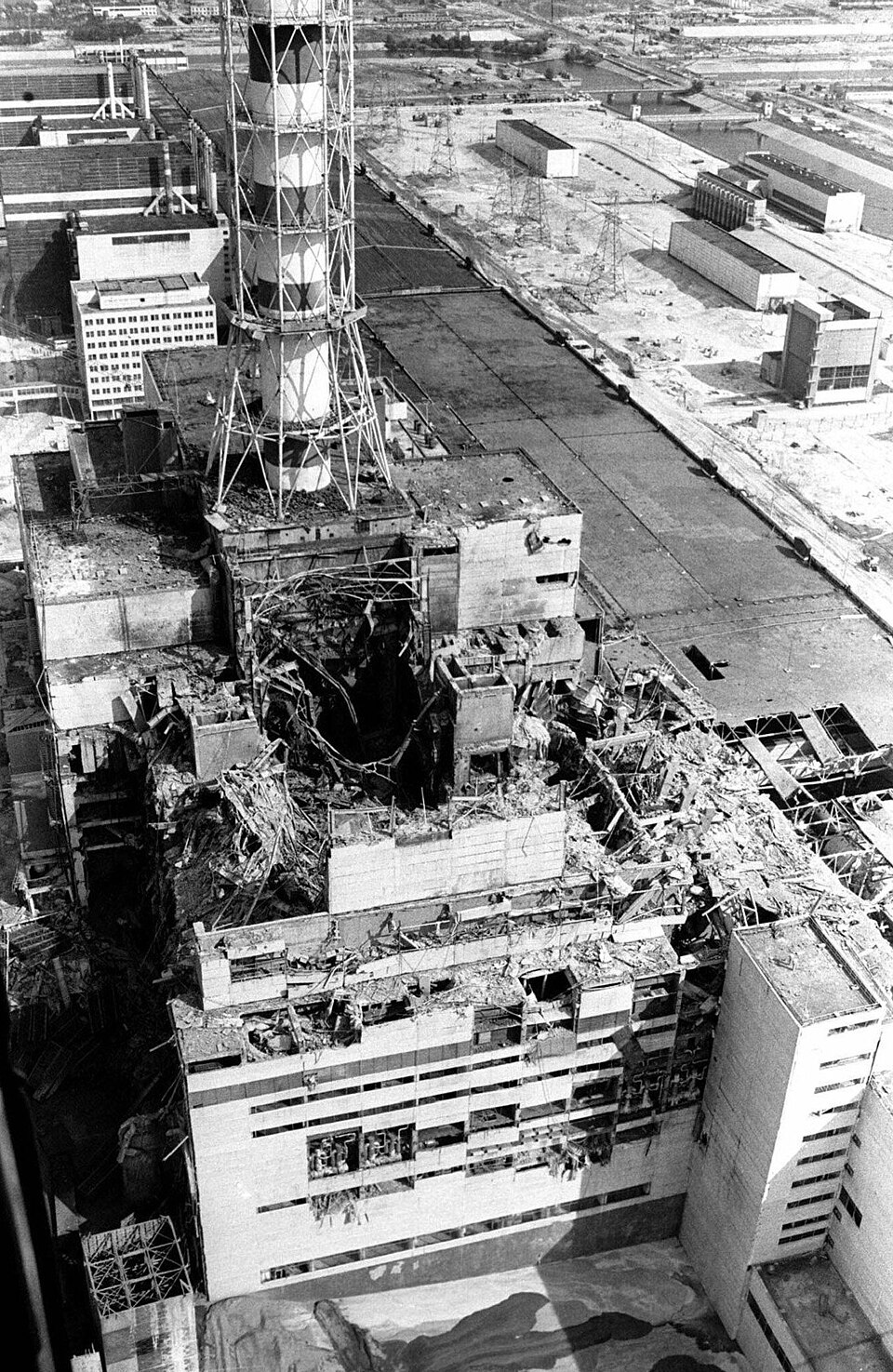
The shift supervisor attempted an emergency shutdown by re-inserting the control rods. However, the extreme temperatures and pressure had already warped the fuel channels, preventing the rods from fully entering the core. The pressure from the superheated, rapidly vaporizing water became immense. A powerful steam explosion ruptured the reactor vessel, blowing off the massive 1,000-ton concrete lid. Moments later, a second, more powerful explosion – likely caused by hydrogen gas generated by the superheated steam reacting with zirconium – completely destroyed the reactor building, sending radioactive debris and the reactor's graphite moderator soaring up to 1,200 meters into the atmosphere.
This catastrophic event marked the definitive "Super-GAU." The uncontained release of radioactive materials – including highly dangerous radionuclides like Iodine-131, Cesium-137, Strontium-90, and Plutonium – began immediately. A massive graphite fire ensued, burning for ten days and continuously spewing more radioactive particles into the sky. For a comprehensive timeline of the disaster, see Chernobyl Disaster 1986: What Happened on April 26th?.
Europe Under a Radioactive Cloud: A Delayed Awakening
The immediate vicinity of Chernobyl was instantly contaminated. A 30-kilometer exclusion zone was quickly established, leading to the rapid evacuation of hundreds of thousands of people, including the entire population of Pripyat. However, the impact was not confined to a localized area. Propelled by prevailing winds, the radioactive cloud began its silent, invisible journey across the continent.
Astonishingly, the Soviet authorities initially kept the accident under wraps. It wasn't until April 28, two days after the explosion, that the world began to grasp the severity of the situation. It was not Moscow that broke the news, but rather scientists in Sweden and Finland, who detected alarmingly high levels of radiation drifting from the Soviet Union. This international detection forced the Soviets to issue a terse statement, acknowledging an accident at Chernobyl.
The radioactive plume spread widely, affecting countries far from Ukraine. Scandinavia, Eastern Europe, and parts of Western Europe, including Germany, received significant fallout. In Germany, Bundesinnenminister Friedrich Zimmermann (CSU) initially downplayed the threat, stating in a television interview that a danger to the German population was "absolutely to be excluded." However, as more data emerged and public concern mounted, this assessment proved tragically inaccurate.
The fallout led to widespread contamination of agricultural produce, particularly milk, fresh vegetables, mushrooms, and wild berries. Governments across Europe issued advisories, sometimes conflicting, on consumption restrictions. Public fear and uncertainty grew, leading to significant societal and economic disruptions. The long-term health effects of this widespread, low-level radiation exposure remain a subject of ongoing study and debate, though an increase in thyroid cancers, particularly among children, was directly linked to the accident.
Long-Term Legacy and Lessons Learned
The Chernobyl disaster left an indelible mark. The exclusion zone, an area of over 2,600 square kilometers, remains largely uninhabitable for humans, though it has become a unique, unintended wildlife sanctuary. Hundreds of thousands of "liquidators" – soldiers, firefighters, and other workers – risked their lives to contain the initial catastrophe and clean up the aftermath, many suffering severe health consequences.
The immediate response involved the construction of a hasty "sarcophagus" over the damaged reactor to contain the remaining radioactive materials. This temporary structure eventually deteriorated, leading to the construction of the New Safe Confinement (NSC), a colossal arch-shaped structure completed in 2016, designed to safely enclose the reactor for at least 100 years. This engineering marvel stands as a testament to the enduring challenge of managing the legacy of Chernobyl.
Globally, Chernobyl spurred a radical overhaul of nuclear safety standards. It led to:
- Improved Reactor Designs: Lessons from Chernobyl prompted the redesign of reactors and the phasing out of RBMK-type reactors, or at least extensive modifications to improve their safety.
- Enhanced Safety Culture: A greater emphasis was placed on operator training, human factors, and independent regulatory oversight.
- International Cooperation: Organizations like the IAEA strengthened their role in promoting nuclear safety and emergency preparedness worldwide.
- Public Awareness: The disaster dramatically increased public and political awareness of the risks associated with nuclear power, influencing energy policies in many countries.
Conclusion
The question, Wann war das Unglück in Tschernobyl?, leads us to April 26, 1986 – a date etched into collective memory as a stark reminder of the immense power and potential dangers of nuclear technology. The Chernobyl Super-GAU was a confluence of flawed reactor design, human error, and systemic operational shortcomings within the Soviet system. Its radioactive cloud darkened Europe, ignited widespread panic, and forced a global reckoning with nuclear safety. While the wounds of Chernobyl continue to heal, the disaster remains a crucial lesson, underscoring the paramount importance of stringent safety, transparency, and international cooperation in any endeavor involving such powerful forces.